Why we build a test board before the real one
The part of Patch that reads the pulse with light is the one part of the board we have not laid out yet. A small test board goes first.
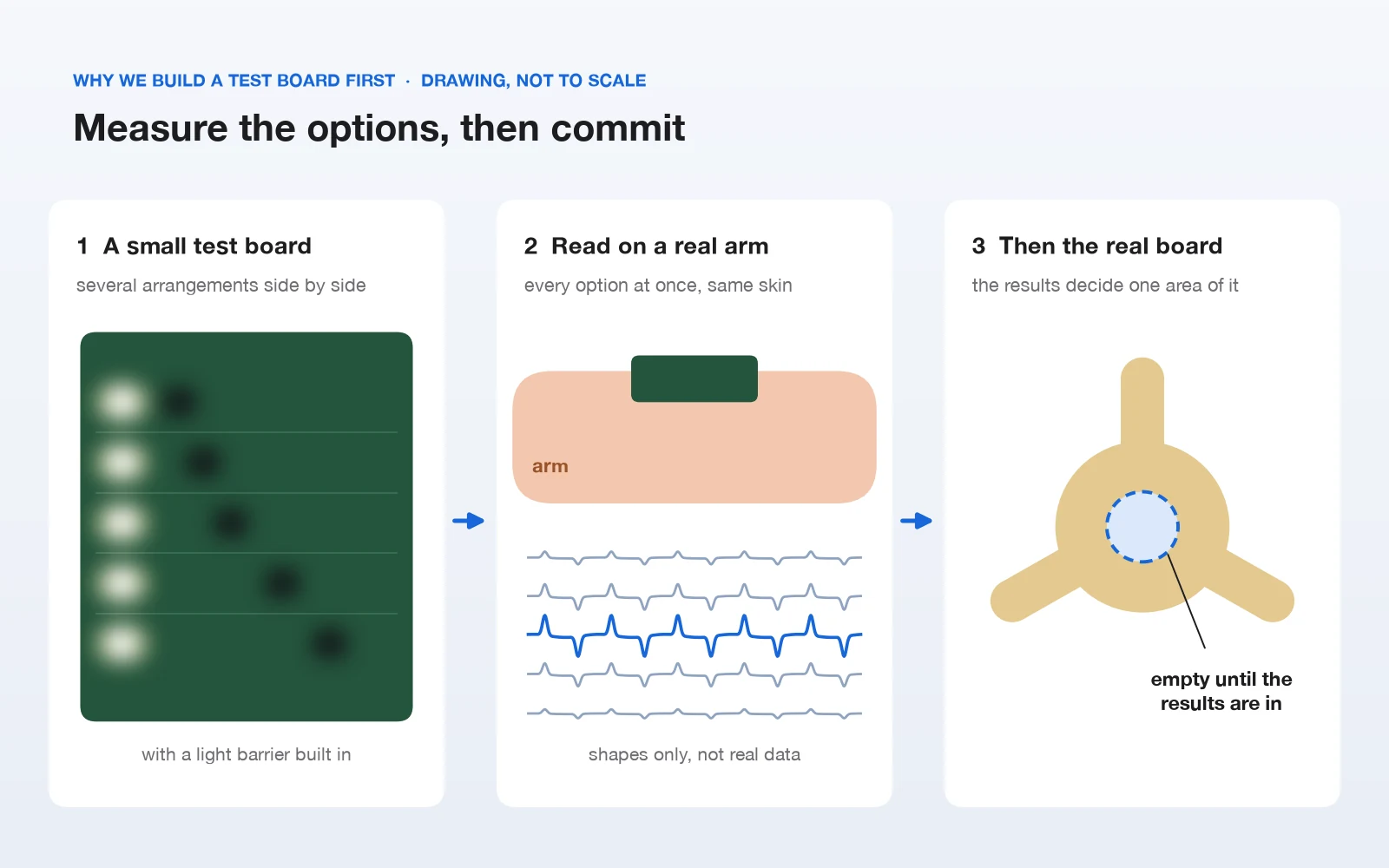
Most of Patch’s production board is placed. One area of it is still empty on purpose: the spot where the LEDs and the light sensor will sit. Where exactly they go, how far apart they are, and what stands between them decide how good every heartbeat reading will be, and those are the choices we trust least to a calculation. So before that area is drawn, a small, separate board measures the options.
One board, several answers
The test board is small and rigid, and it is not a product. It carries several arrangements of LEDs and light sensors side by side, each one a different answer to the same question. All of them are read in a single sitting, under the same conditions, on the same arm, so they can be compared fairly: same skin, same temperature, same pressure, same minute. Testing the options one board at a time over different days would mix the differences we care about with differences we don’t.
It carries the parts that matter for the comparison and very little else, and the factory assembles all of it, so the readings reflect the design rather than how carefully something was put together by hand.
What only a real arm can say
We simulated light in skin before drawing anything (that story has its own post), and the simulations narrowed the options a lot. But the most important quantity in the whole design comes from the body, not from physics: how big the pulse in the light actually is, on a real arm. Everything else scales with it. A model has to take it from measurement, and the test board is where that measurement will come from.
The board is also built to measure what goes wrong. One run looks at light that reaches the sensor without ever entering the skin, the stray light a barrier is meant to block. Another reads the sensor with the LEDs off, to see how quiet it is on its own. Those two floors tell us how much of a reading is signal and how much is the device talking to itself.
The first version never went out
An earlier version of the test board was designed and ready, and we never ordered it. When the simulations came back, they showed it was testing the wrong range: some of its options were so far from the likely answer that they would have taught us little, while the region that mattered had too few. Rather than order a board we already expected to disappoint, we redrew it around what the simulations said, with a light barrier built in as part of the kit instead of added later.
That redesign was cheap because nothing had been built. The same change after ordering would have cost a manufacturing run and weeks of waiting. Asking the question on paper first, then on a small board, then on the real thing keeps each step’s mistakes as cheap as they can be.
Checked before it is bought
Before any money is spent on it, the test board gets the same scrutiny as the real one. Every pin was checked against its datasheet, every part’s footprint against the factory’s own library, and every manufacturing file was regenerated and read back. Each of those checks was first made to catch a mistake we planted on purpose (why that matters). The verdict was to go ahead, with a short list of fixes.
The board is designed and checked, and its parts are ready to order. It has not been built or run yet. When it has, its results will decide that empty area of the production board.