Sticking to skin for weeks
Patch is designed to stay on for weeks. The adhesive that holds it there is one of the hardest choices in the project, and it has not been made yet.
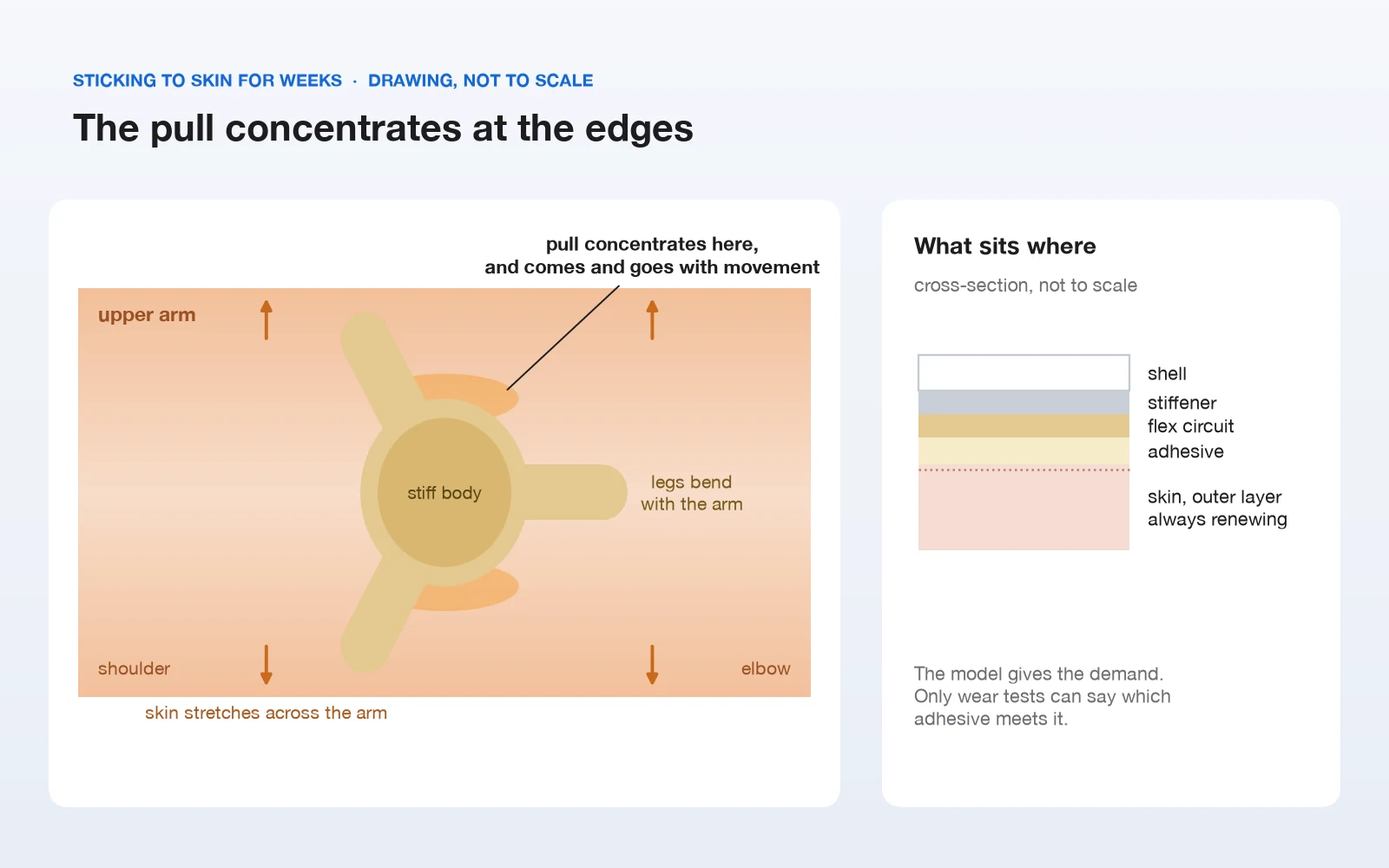
Most of the engineering in Patch is electronics. The part most likely to decide whether people like wearing it is not. It is the thin layer between the patch and the skin. If the adhesive gives up, nothing else matters; if it holds too hard or leaves the skin unhappy, nobody will want to wear the next one.
What the adhesive has to do
The list sounds simple. It has to hold for weeks, not hours. It has to keep holding while the arm moves, flexes and stretches all day. It has to let the skin underneath stay comfortable. And at the end it has to come off cleanly, without hurting. Each of those pulls against another: an adhesive that holds harder is usually harder to remove, and one that is gentler on removal usually lets go sooner.
Skin makes it harder still. Its outer layer is constantly renewing itself, so an adhesive that stays on for weeks is holding onto a surface that is slowly leaving.
Shape helps
Patch’s shape is part of the answer. A round body carries the electronics, and three legs reach out from it, each one adhesive. The legs spread the hold over a wider area than the body alone and bend with the arm, so the body does not have to. The body itself is stiffened to protect the circuit, which is exactly why it cannot stretch with the skin beneath it.
The edges are where it fails
We modelled how the stiff body and the moving arm pull on the adhesive. The model does not predict the whole patch slowly peeling away. It predicts the pull concentrating at the edge, at the points across the arm, and coming and going with movement rather than building steadily. That matters because it says where to look: the edge needs the most from the adhesive, and what sits at the edge matters more than how thin the body is.
What the model cannot do is say whether any particular adhesive will hold. How an adhesive grips living skin over weeks is biology as much as physics, and no equation predicts it. The model gives the demand. Only wearing it gives the answer.
Where it stands
No adhesive has been chosen. We have asked for samples of several long-wear tapes made for skin, and the wear tests have not started. When they do, they will put candidate adhesives on real arms for weeks, watch where the edges start to lift and how that follows movement, and try the body with different amounts of stiffening, including none, to see how much it changes the hold.
One decision elsewhere already helps. Because Patch charges without coming off, the adhesive only has to make one trip onto the skin and one trip off. Every removal it never has to survive is a removal it cannot fail.