Making a small battery last weeks
Patch has to run for weeks on a battery small enough to wear. That only works if every part of the circuit earns the power it uses.
A patch you wear for weeks cannot carry much battery. It has to be thin, light and comfortable, and the battery is the biggest single thing in it. So the question is not how big a battery we can fit. It is how little power the rest of the patch can get by on.
A budget, like money
We keep a power budget the way you would keep a household budget. A small program lists every part of the circuit, how much it draws when it is working, how much when it is asleep, and how often it wakes. It adds them up into the average the battery has to supply, and from that, how long a given battery lasts. Every line comes from the part’s datasheet, and every part gets two figures: the typical one, and the worst case the datasheet allows. The battery has to cover the worst case, not the hopeful one.
Nothing joins the design without a line in the budget. When we recently added a part, the budget showed what it would cost over a full wear before it went in. The answer was a small fraction of a day, so it went in.
Almost everything is asleep, almost all the time
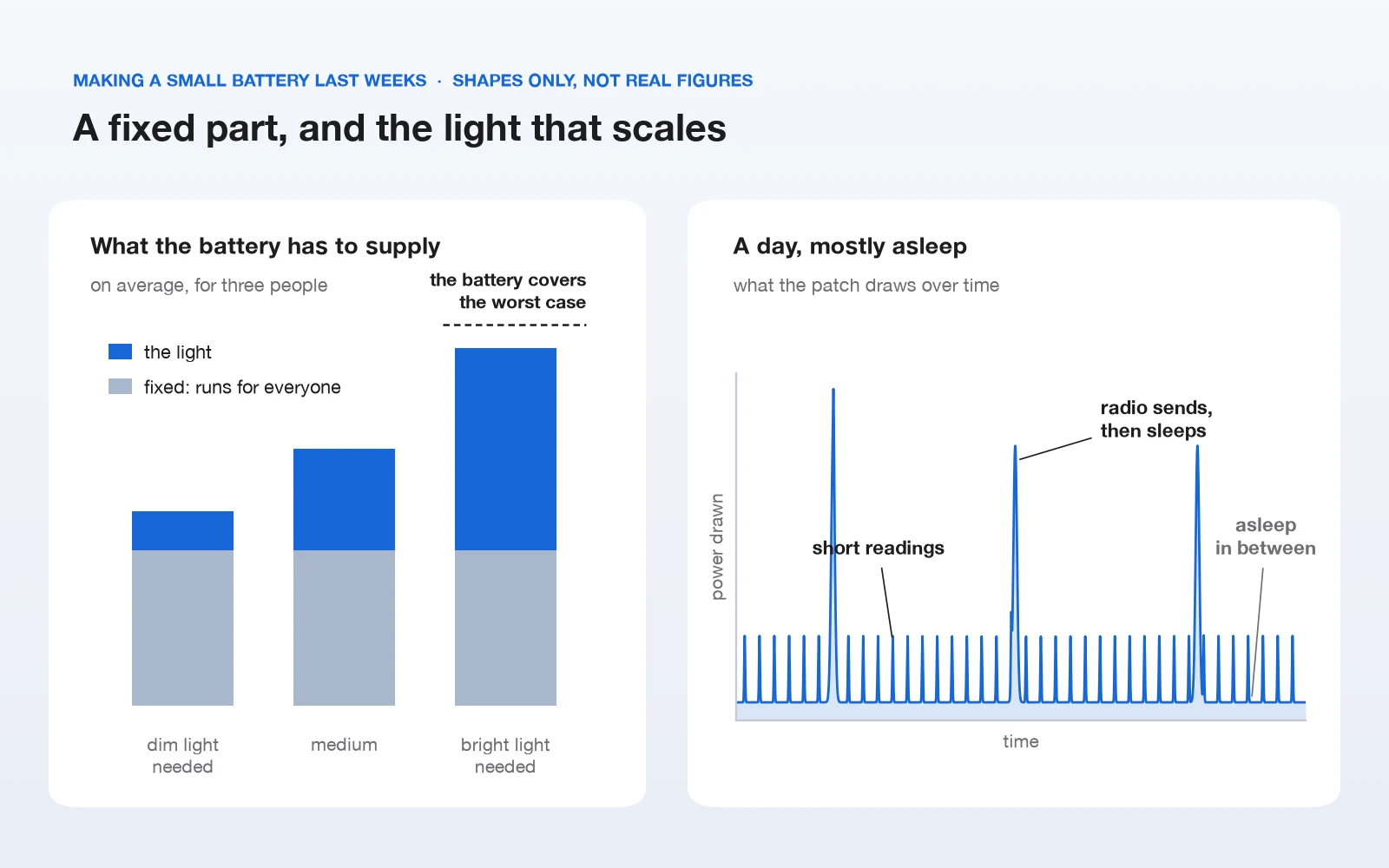
The trick is that very little of Patch needs to be awake at once. In the design, the radio wakes, sends what it has and goes back to sleep; the temperature sensors take a reading and power down until the next one; the processor sleeps between tasks. Over a day, all that sleeping is what makes weeks possible, and it is why the “asleep” figures in the budget matter as much as the “working” ones.
Even the small losses in the circuit’s own power regulation are counted rather than rounded away. On a budget this tight, the small lines add up.
The light is the part that moves
The budget splits cleanly in two. One part is fixed: everything that has to run no matter who is wearing the patch. The other is the light, the LEDs that shine into the skin for the heartbeat reading. That part scales, because how bright the light has to be depends on the person, on their skin, and on how far the light travels to the sensor. At the bright end it becomes the biggest cost in the whole budget.
That is why the battery itself is not chosen yet. Its size waits on a bench test that measures how much light a clean reading really needs (the test board is part of that). Choose the battery first and you either carry more than you need or run out early.
Only the light each person needs
Because the light scales, the plan is for the firmware to set it for each person: start from what the sensor sees, and use only as much light as a clean reading needs. The simulations suggest most people, most of the time, will sit at the low end. That turns the budget from one fixed answer into a range, with the worst case still covered by the battery.
One last habit: Patch is meant to leave the factory switched fully off and wake on its first charge (more on that), so its weeks start when the wearer’s do.